High-impact virtual tutoring program
HIGH-IMPACT VIRTUAL TUTORING
More than tutor time.
A program built to help students think, participate, and grow.
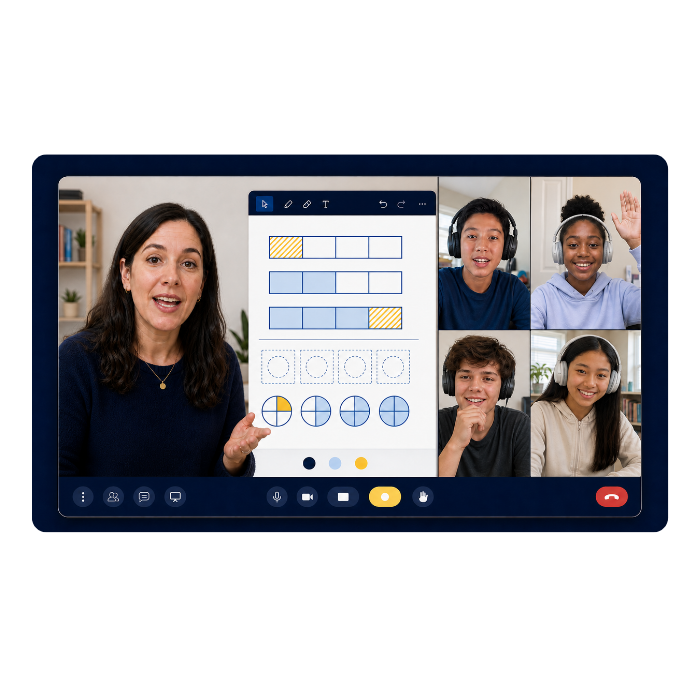
Cignition brings live tutors, purpose-built math and ELA instruction, useful data, and hands-on implementation support together in one connected program, configured around the students, schedule, and priorities.
A strong program makes the work before, around, and after each session explicit. The five stages below show how an initial need becomes a supported implementation, and how the experience informs what happens next.
HOW THE PROGRAM WORKS
Five stages carry the work from purpose to improvement.
Open each step to see the distinct job it performs in the program lifecycle.
Define the purpose
Be clear about the need tutoring is meant to address.
The work starts by identifying the learners, academic priorities, and local context the program needs to respond to. That creates a useful definition of success before schedules and rosters take over the conversation.
- Students to be served
- Academic focus
- Meaningful signs of progress
Configure the model
Build an operating plan the school can actually sustain.
Session length, frequency, group size, scheduling, and on-site support are planned together. The goal is a model that gives students a realistic path to consistent participation and the intended dosage.
- Schedule and frequency
- Group size and rosters
- On-site roles and access
Prepare for launch
Turn the plan into groups, access, and a ready first session.
Cignition translates the agreed model into rosters, access, an instructional starting point, and a coordinated first-session plan.
- Tutor and group readiness
- Starting instructional focus
- Technology and launch coordination
Support participation
Keep implementation barriers from becoming the program.
Once sessions begin, the work shifts to follow-through. Cignition and the partner stay connected around attendance, access, communication, and emerging issues so practical changes can happen while they still matter.
- Attendance follow-through
- Access and scheduling issues
- Clear communication paths
Review and decide
Use the full implementation story to plan what comes next.
Scheduled reviews bring the partner and Cignition back to the original purpose. Together, the teams consider what students experienced, whether the model operated as intended, and what should continue or change.
- Progress toward the purpose
- Implementation context
- Next-step decisions
DATA WITH A JOB TO DO
Useful signals.
Practical decisions.
Better questions.
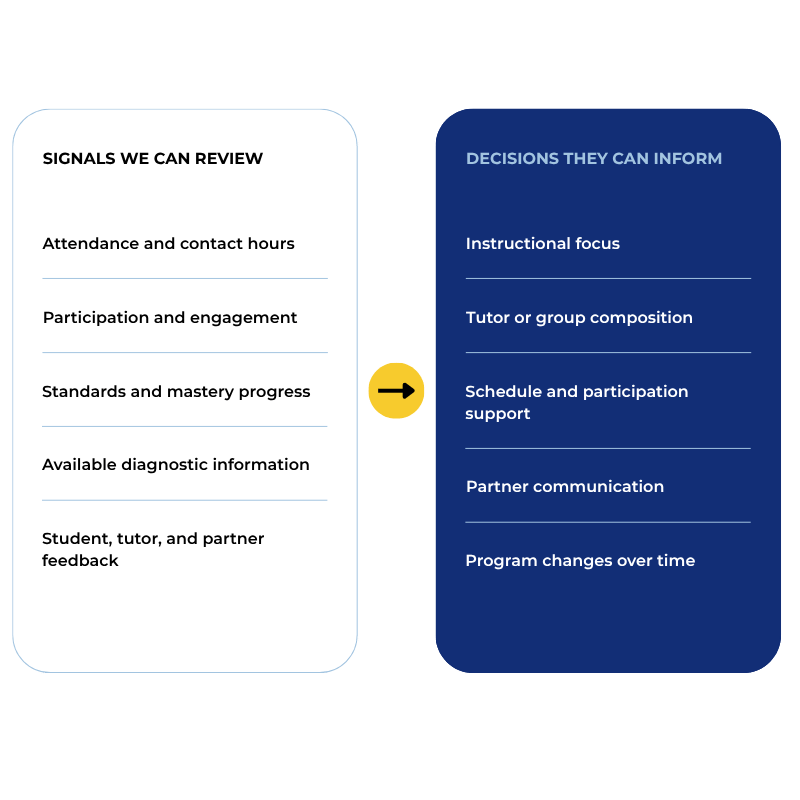
Data-informed instruction and implementation help the team respond while a program is underway. Data-driven continuous improvement helps Cignition and its partners learn across the full program.
A RESPONSIBLE EVIDENCE STORY
Research gives us a foundation, not a shortcut.
Independent randomized studies found statistically significant learning gains in specific fifth-grade fractions programs using Cignition’s one-to-one and small-group tutoring models. Those findings are an important part of our evidence base, alongside case studies and implementation data from real programs.
We use each source for what it can tell us: research to test specific questions, program data to track implementation and student progress, and partner context to understand what the numbers do and do not mean.
MTSS INTEGRATION
Give tutoring a defined job inside the support system.
Cignition does not replace a school’s MTSS, core instruction, or local intervention team. It adds instructional capacity to address an identified need within the system the school already leads.
The goal is connection: a clear role for tutoring, useful visibility for the local team, and no claim that one outside service can stand in for the full system of support.
Core instruction and the school's intervention system remain central.
Educators and local teams have the most complete view of student needs, classroom priorities, and the supports already in place.
Tutoring takes on a specific, bounded instructional role.
Cignition adds recurring small-group time and focused math or ELA instruction for the learners and needs the partner identifies.
Shared visibility helps the larger system respond.
Program signals add context for local review. School teams retain responsibility for decisions across tiers, services, and the student’s broader plan.
WHAT STRONG IMPLEMENTATION ASKS
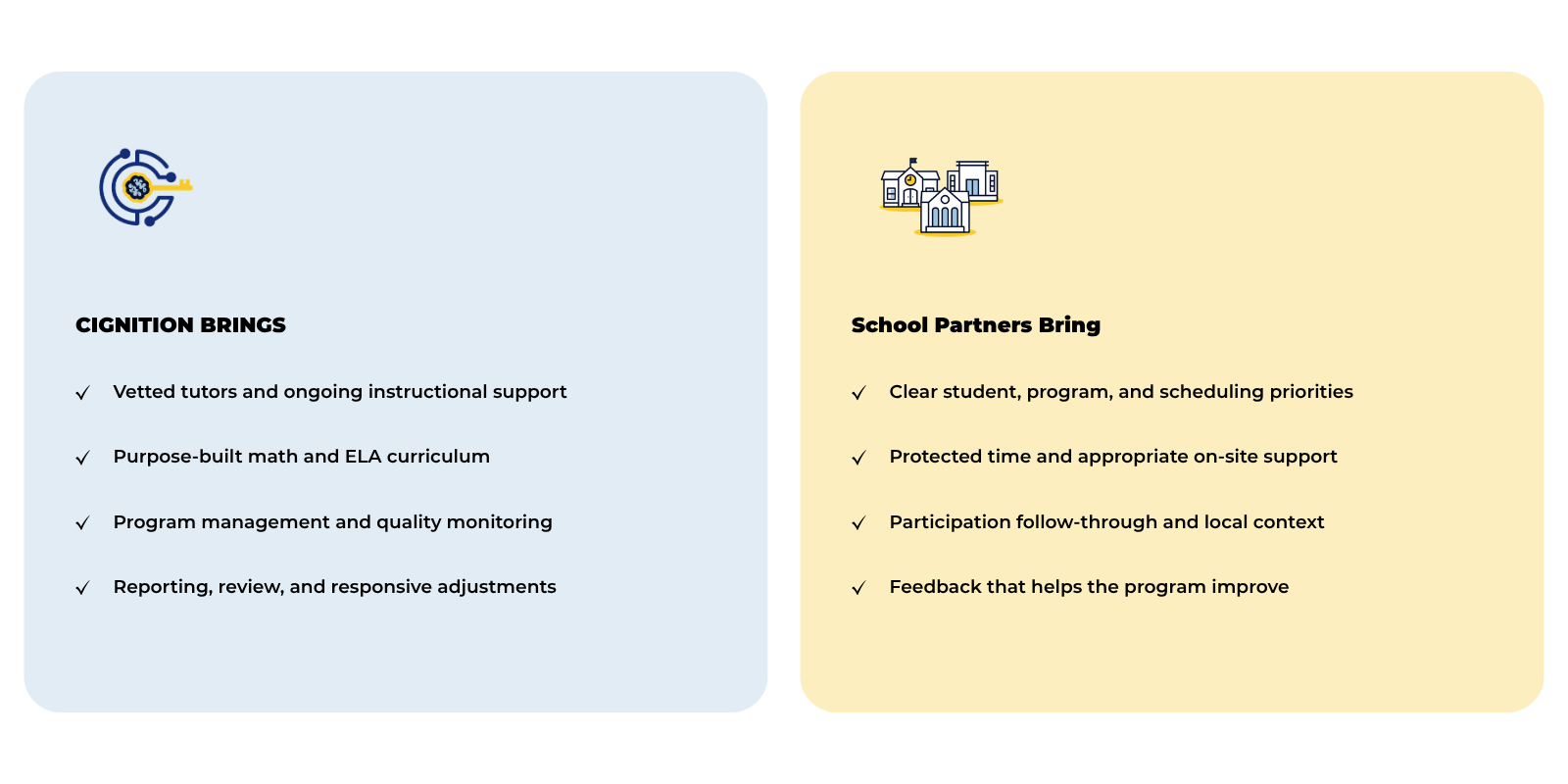
The work is shared.
So is the learning.
We do not treat every implementation as interchangeable. A strong program depends on clear roles, protected time, and ongoing communication from both sides.
MTSS ADVISORY BOARD
Perspectives connected
to real schools.
Cignition’s MTSS Advisory Board brings perspectives from district leadership, research, school practice, psychology, intervention, and educational equity.
Special Education Specialist
Rancho Santa Fe School District, CA

Assistant Superintendent, Technology & Innovation
Lynwood Unified School District, CA

Social Studies Concurrent Enrollment Teacher
Viewmont High School, UT

Senior Director
ACT Center for Equity in Learning

Professor and Director
Stanford University and NSSA

Principal Consultant and Owner
OMT Consulting

Director of MTSS
Antelope Valley Union High School District, CA

MTSS Coordinator
Rapides Parish Schools, LA
PROGRAM QUESTIONS
The short, direct version.
Clear answers for school and district leaders evaluating a virtual tutoring partner.
Is Cignition's school tutoring program a fixed package?
No. Cignition offers live virtual K–12 math and ELA tutoring, but the operating model is configured with each partner. Students served, schedule, group size, session frequency, local requirements, and reporting needs can shape the final design.
When can Cignition tutoring take place?
Programs can be scheduled during the school day, in an intervention block, or outside regular instructional hours when the partner can protect recurring time and provide the access students need. The strongest schedule is the one students can attend consistently.
Does a school need standardized test data to begin?
Not necessarily. Cignition can use the academic and contextual information a partner can appropriately share, along with student responses and program evidence gathered during implementation. Standardized test data can add context when available.
Is Cignition a test-prep program?
Test preparation is not Cignition’s primary model. The program focuses on students’ identified math and ELA learning needs and can align instruction to relevant grade-level standards and academic priorities.
Follow the instructional decisions that help students explain ideas, make connections, and use learning in new contexts.
See what Cignition looks for when selecting tutors and how selection, matching, and continued support differ.
START WITH THE NEED
Let's build the right program, not force a standard one.
Tell us about the students, schedule, and goals. We’ll help determine the model and whether Cignition is a fit.